
A great welcome book does something quietly remarkable: it makes guests feel looked after without requiring them to ask for help. It answers the Wi-Fi question before the first message is sent, explains the temperamental coffee machine before breakfast, and gives visitors the confidence to enjoy both your property and the neighbourhood around it.
The best versions are not encyclopaedias. They are clear, warm and easy to scan on a phone. Use this complete Airbnb welcome book checklist to cover every useful detail—then remove anything that does not help a guest act, decide or feel more at home.
The Quick-Start Essentials
Put the details guests need in their first ten minutes at the very beginning. If they have to search for them, the guide is working too hard.
- Property address, including postcode and any locally used house name
- Check-in and check-out times
- Wi-Fi network and password, with ambiguous characters clearly distinguished
- Host contact details and the best hours or channel for routine questions
- Emergency contact instructions for urgent property issues
- Parking directions, restrictions, permits and EV charging guidance
- Door, lockbox or smart-lock instructions, ideally with a photograph
- One-sentence orientation: where to find keys, heating controls and the welcome guide
A guest arriving after dark, in the rain, with a low phone battery should still be able to find the door, enter the property and connect to Wi-Fi without messaging you.
A Warm, Useful Welcome
Begin with two or three short paragraphs in your own voice. Welcome the guest, share what you love about the property and set expectations for how available you will be during their stay. Keep the biography brief: this page is there to reassure, not delay the information they came to find.
Include:
- A personal welcome from the host or team
- A short description of the property and its character
- How and when guests can contact you
- A note about any welcome gift or complimentary provisions
- The one thing you most want guests to enjoy during their stay
Arrival and Access
Familiar instructions can become surprisingly unclear to somebody seeing the property for the first time. Write this section as though you are guiding a friend from the nearest main road to the front door.
- Driving directions for the final approach, including easy-to-miss turns
- Public transport options and the nearest practical taxi service
- Where to park, unload luggage and display any permit
- Step-by-step entry instructions
- What to do if the code or key does not work
- Accessibility details: steps, gradients, doorway widths or lift access
- Exterior lighting instructions for late arrivals
- Seasonal access notes, such as icy lanes, gates or high-tide restrictions
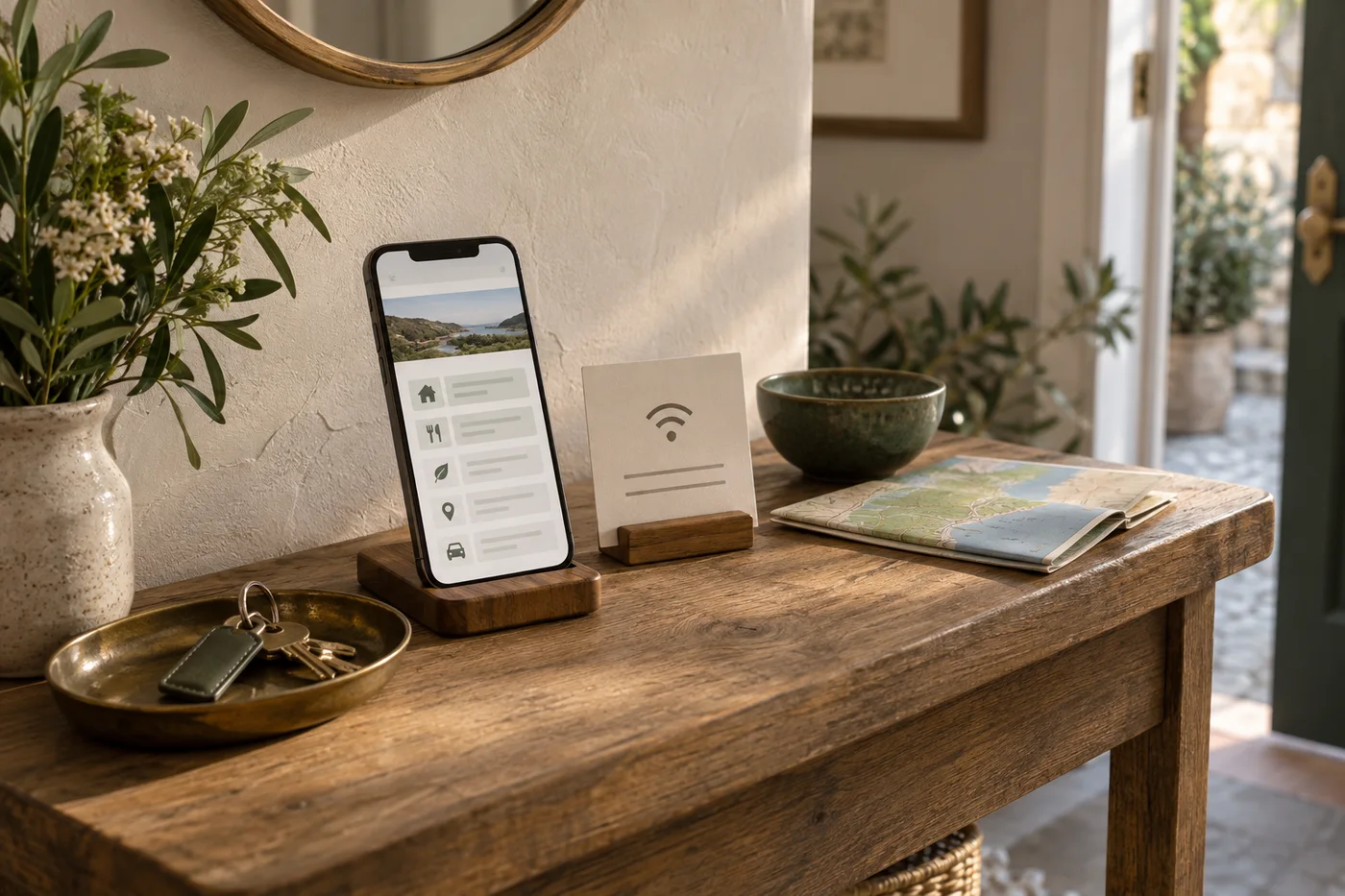
Wi-Fi, Technology and Entertainment
Do not stop at the password. Guests need to know how the property's technology behaves, especially when the controls differ from those at home.
- Wi-Fi name, password and router location
- What to try first if the connection drops
- Television and streaming instructions
- Speaker, projector, games console or cinema-room guidance
- Smart-home controls and privacy information
- Charging points and any provided adaptors
- Workspace details, including desk location and expected internet speed
Never include passwords for host accounts. Invite guests to use their own streaming login and remind them to sign out before departure.
Heating, Cooling and Hot Water
Temperature questions create some of the most avoidable mid-stay messages. Photographs of unfamiliar controls can explain more than a paragraph of text.
- Thermostat location and simple operating steps
- Heating or air-conditioning schedule
- Underfloor heating response time
- Fireplace or wood-burner safety instructions
- Fan locations and ventilation guidance
- Hot-water system notes and recovery time
- Who to contact if the property is too hot, cold or without hot water
Kitchen and Dining
Focus on anything that is unusual, easy to misuse or difficult to find.
- Hob, oven, microwave and extractor instructions
- Coffee machine type and operating steps
- Dishwasher tablets and basic cycle guidance
- Drinking-water information
- Recycling, compost and general-waste locations
- Where to find child-friendly tableware or a highchair
- Outdoor cooking or barbecue instructions and safety rules
- Nearby food shops, their opening hours and delivery options
Bedrooms, Bathrooms and Laundry
Small orientation details make a property feel intuitive rather than unfamiliar.
- Spare bedding, blankets and pillows
- Cot, travel bed or blackout-blind instructions
- Hairdryer, iron and ironing-board locations
- Shower, bath or water-pressure quirks
- Towels intended for the beach, pool or hot tub
- Washing machine, dryer and drying-rack instructions
- Septic-system or plumbing guidance, where relevant
- Where guests can store luggage
Amenities and Outdoor Spaces
List every feature that needs a safety note, a cover removed, a switch found or an advance booking.
- Pool, hot tub or sauna operating hours and safety guidance
- Garden gates, outdoor lighting and furniture storage
- Beach, ski, cycling or sports equipment
- Games, books and children's equipment
- Pet provisions and restricted areas
- Shared-space etiquette
- Firepit, barbecue or outdoor-heater instructions
- Any amenity that is seasonal or weather-dependent
House Rules That Guests Will Read
Keep rules concise, group them by moment and explain the reason when it is not obvious. A considerate sentence usually earns better cooperation than a wall of capital letters.
- Maximum occupancy and visitor policy
- Smoking or vaping policy
- Pet rules
- Quiet hours and neighbour considerations
- Parties and events policy
- Shoes, food or restricted-room guidance
- Security-camera and noise-monitor disclosure
- Damage-reporting process
Phrase rules as hospitality wherever possible: “Our neighbours value the stillness of the lane, so please keep outdoor conversation low after 10 pm” is clearer and warmer than “NO NOISE”.
Safety and Emergencies
This section must be easy to find and specific to the property. Check local regulations and platform requirements rather than treating any generic list as legal advice.
- Local emergency-services number
- Full property address for callers to read aloud
- Nearest hospital, urgent-care service and pharmacy
- Fire exits and the outdoor meeting point
- Fire extinguisher and fire-blanket locations
- First-aid kit location
- Smoke and carbon-monoxide alarm information
- Main water stopcock, fuse box and gas shut-off location, where appropriate
- Instructions for power cuts, severe weather or local hazards
Keep emergency information available offline as well as digitally. A small printed card near the entrance or kitchen is a sensible backup when power or mobile service fails.
Local Recommendations
A welcome book becomes memorable when it offers judgement rather than a directory. Choose a short, confident list and explain why each place deserves a guest's limited holiday time.
- Best nearby breakfast and coffee
- Reliable lunch and dinner choices, with booking advice
- Groceries, pharmacy and other practical stops
- Family-friendly and rainy-day activities
- Walks, beaches, viewpoints or cultural highlights
- Your favourite lesser-known local experience
- Accessibility, pet-friendly and dietary notes
- Transport, parking and seasonal opening information
Add map links, telephone numbers and reservation links. Review every recommendation at least quarterly; an outdated opening time can undo the trust created by the rest of the guide.
Check-Out Without the Guesswork
A good departure list is short enough to complete. Separate genuine necessities from tasks your turnover team can reasonably handle.
- Check-out time and any flexibility policy
- Where to leave keys or how to lock the smart lock
- Essential washing-up or dishwasher request
- Where to place rubbish and recycling
- Windows, heating and appliance instructions
- What to do with used towels
- Lost-property contact process
- A polite invitation to leave a review
Final Quality Check Before You Publish
Walk through the property with the guide open and test every instruction as a guest would.
- Verify every fact. Test links, codes, phone numbers and appliance steps.
- Scan it on a mobile. Important answers should be readable without pinching or zooming.
- Use clear headings. A guest should find Wi-Fi, parking or check-out in seconds.
- Add useful photographs. Show the correct gate, lockbox, thermostat and appliance controls.
- Remove repetition. Keep one source of truth instead of several slightly different instructions.
- Protect private information. Never publish personal alarm codes, host passwords or details guests do not need.
- Create an offline fallback. Make safety and access essentials available when connectivity fails.
- Set a review date. Recheck the guide after property changes and at least once each season.
Paper or Digital?
A printed book feels tangible and works without power, but it becomes dated quickly and cannot help a guest before arrival. A digital welcome book is searchable, easy to update, accessible from the journey onwards and able to link directly to maps, bookings and instructions.
For most hosts, the strongest arrangement is a digital guide as the living source of truth, supported by a small printed card containing the Wi-Fi, host contact and emergency essentials.
The goal is not to include the greatest possible amount of information. It is to make the right information effortless to find. When your welcome book anticipates real moments in the guest journey, fewer questions reach your inbox—and the stay feels thoughtful from the very first turn of the key.